
Date: 14-APRIL-2020 Last Updated: 19-AUGJST-2026
Overview
The retention of polar compounds using HILIC conditions on TYPE-C™ silica hydride stationary phases has been the subject of extensive scientific investigation. Significant advances have been made in understanding how these materials retain hydrophilic analytes and how their behavior differs from both conventional HILIC stationary phases and traditional reversed phase chromatography.
This discussion applies specifically to TYPE-C™ silica hydride-based columns, including but not limited to:
- Cogent™ Diamond Hydride™
- Cogent™ Phenyl Hydride™
- Cogent™ Amide™
- Cogent™ Silica-C™
These stationary phases share the silica hydride surface chemistry that gives rise to their unique retention characteristics when operated under HILIC conditions.
HILIC Retention on TYPE-C™ Columns
HILIC methods are commonly used for the separation of polar compounds using organic-rich mobile phases. While many HILIC columns rely on highly hydrophilic stationary phases and a water-rich surface layer to achieve retention, studies have shown that TYPE-C™ silica hydride phases behave differently.
Research has demonstrated that the amount of water adsorbed onto a silica hydride surface is extremely low, averaging approximately one-half of a monolayer under typical chromatographic conditions.
Because the surface water layer is so limited, the retention process observed on TYPE-C™ columns differs from the partitioning mechanisms commonly associated with conventional HILIC materials.
Surface Characteristics of Silica Hydride Phases
Several investigations have examined the behavior of silica hydride stationary phases in the presence of typical HPLC solvents and mobile phase additives.
These studies have confirmed:
- Extremely low levels of adsorbed surface water
- Rapid equilibration characteristics
- A strongly negative surface charge under chromatographic conditions
- Surface behavior distinct from conventional silica-based HILIC phases
The origin of this surface charge appears to differ significantly from the mechanism generally observed on traditional silica materials.
Origin of the Surface Charge
Conventional silica phases derive much of their surface behavior from silanol groups present on the stationary phase surface.
In contrast, TYPE-C™ silica hydride materials consist predominantly of: Si-H (silica hydride) groups
Studies indicate that the strong negative surface charge is associated with an accumulation of hydroxide ions originating from the aqueous component of the mobile phase rather than from large populations of surface silanols.
This phenomenon has also been observed in other mildly hydrophobic interfaces where hydroxide ions preferentially accumulate near the surface.
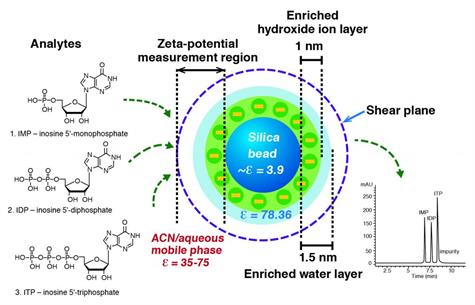
Figure 1. Composition of environment near the surface of a particle with a silica hydride surface. The ε value is the zeta potential indicating high negative charge near the surface.
Adapted from Ref. 3
Proposed Retention Mechanisms
Based on currently available research, polar analyte retention on TYPE-C™ columns under HILIC conditions is believed to involve several possible interactions.
Positively Charged Compounds
Retention may result from:
- Electrostatic attraction
- Ion-interaction effects
- Surface charge interactions
Negatively Charged Compounds
Retention may involve:
- Ion displacement processes
- Competitive surface interactions
Neutral Polar Compounds
Retention is most likely associated with:
- Adsorption interactions
- Surface displacement effects
- Specific analyte-surface interactions
These mechanisms differ substantially from the water-layer partitioning model commonly proposed for traditional HILIC phases.
Equilibration Advantages
One practical observation supporting these differences is the rapid equilibration behavior often exhibited by TYPE-C™ columns.
Compared to many conventional HILIC stationary phases, silica hydride materials typically require less time to achieve stable retention following mobile phase changes.
This behavior is consistent with the presence of a much thinner surface water layer than that observed on many highly hydrophilic HILIC phases.
Significance for Method Development
Understanding the unique surface chemistry of TYPE-C™ columns can help explain:
- Strong retention of polar analytes
- Rapid equilibration
- Excellent LC-MS compatibility
- Distinct selectivity compared to conventional HILIC columns
- Reproducible retention behavior
These characteristics have contributed to the successful use of TYPE-C™ columns in applications involving:
- Metabolomics
- Pharmaceutical analysis
- Clinical research
- Food and beverage testing
- Environmental analysis
- LC-MS methods
Key Takeaways
- TYPE-C™ silica hydride columns provide HILIC retention through mechanisms distinct from many conventional HILIC phases.
- Research indicates that silica hydride surfaces contain only a very thin adsorbed water layer.
- Retention appears to involve surface interactions, electrostatic effects, adsorption processes, and ion-displacement mechanisms.
- The discussion applies specifically to TYPE-C™ phases such as Diamond Hydride™, Phenyl Hydride™, Amide™, and Silica-C™.
- Rapid equilibration and unique selectivity are characteristic features of silica hydride stationary phases.
- These properties make TYPE-C™ columns valuable tools for the analysis of challenging polar compounds.
References
- Soukup, J.; Janas, P.; Jandera, P. Journal of Chromatography A, 1286 (2013) 111-118.
- Kulsing, C.; Yang, Y.; Munera, C.; Tse, C.; Matyska, M.T.; Pesek, J.J.; Boysen, R.I.; Hearn, M.T.W. Analytica Chimica Acta, 817 (2014) 48-60.
- Kulsing, C.; Nolvachai, Y.; Marriott, P.; Boysen, R.; Matyska, M.; Pesek, J.; Hearn, M. Journal of Physical Chemistry B.
